


Radios to Readiness: Six Months at MCM
Stepping into the CEO seat at MCM Technology six months ago meant inheriting two decades of trust built with public safety agencies and assuming the responsibility to help more people do their mission-critical jobs every day.
I started by listening. Sitting down with leaders from some of the largest public safety agencies in the country, I kept hearing the same two things:
- Customers deeply valued the MCM partnership, our team and the expertise we bring to the table.
- Our technology was really good at helping them solve their most critical operational challenges, answering questions like, “Where is the equipment?” “Who has it” “Is it certified?” and “Is it due for service?”
I quickly understood that while many customers found themselves applying MCM for one specific department — say for radios or weapons alone — all seemed to have the same pain point: the need to run their day-to-day agency operations with accurate, real-time data, without needing to look through multiple systems.
Whether vehicles, radios, evidence or protective gear, the gap was in the “let me check and get back to you” responses. Why? Because that’s where the risk lives.
Intelligent Operational Readiness
Agencies first came to MCM because they needed absolute reliability managing mission-critical radio inventory, and two decades later, that reputation is still the foundation everything else is built on.
What we’ve learned is that the same discipline that made radio tracking dependable — real-time data, no guesswork, always audit-ready — is exactly what agencies need across every asset they’re responsible for. We call this Intelligent Operational Readiness: gear, vehicles, evidence, and certifications, accounted for in real time and in date, with intelligence that tells you what needs attention before it becomes a problem.
The momentum we’re seeing right now, especially in law enforcement, is proof the public safety market wants this single connection point for every asset they own. And it’s not just in police and sheriff departments. Fire crews need to know gear is inspection-ready before a call. EMS agencies need fleets stocked and crews certified at all times. Government and communications teams need every piece of infrastructure accounted for. Different equipment and regulations but the same underlying need: one place to see it all.
The Platform Shift
Throughout my career scaling public safety SaaS, I’ve learned that point solutions have their place, but the real ROI often comes from platforms that have the foundational stack to securely organize data, integrate with existing frameworks and serve as a simple, singular path for success, or escalation.
Tracking equipment gets you inventory. Fully understanding your entire agency’s operations with a click of a button gets you readiness. That distinction is the whole thesis behind what we are building and why it was so exciting to bring aboard Scott Roehrenbeck as CTO this summer who has built his career turning AI ambition into shipped, working product.
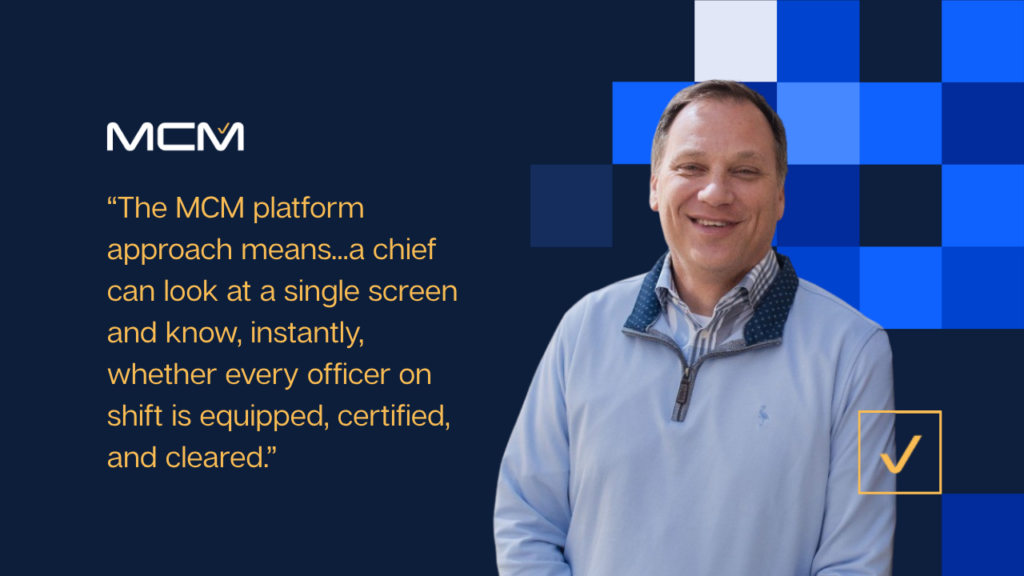
The MCM platform approach means chain of custody and compliance get handled automatically, in the background, instead of getting chased down manually before every audit. It means a chief can look at a single screen and know, instantly, whether every officer on shift is equipped, certified, and cleared.
Building for What’s Next
We’re still early in telling this story. And if I’ve learned anything over the past six months, it’s that the agencies we serve already know what they need. Our job is to build it, prove it works at scale, and keep listening. The next chapter is bigger than anything we’ve announced so far, and I couldn’t be more excited to be on this journey with this hard-working team.
